Industry Knowledge
How the Cross Geometry Multiplies Torque Output: The Physics Behind a Cross Shape Lug Wrench
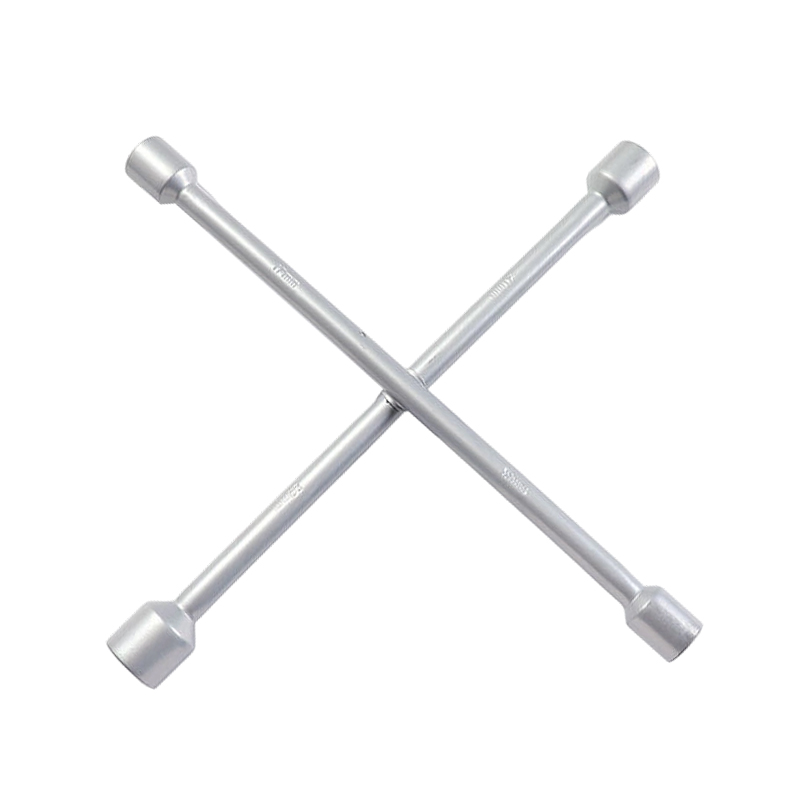
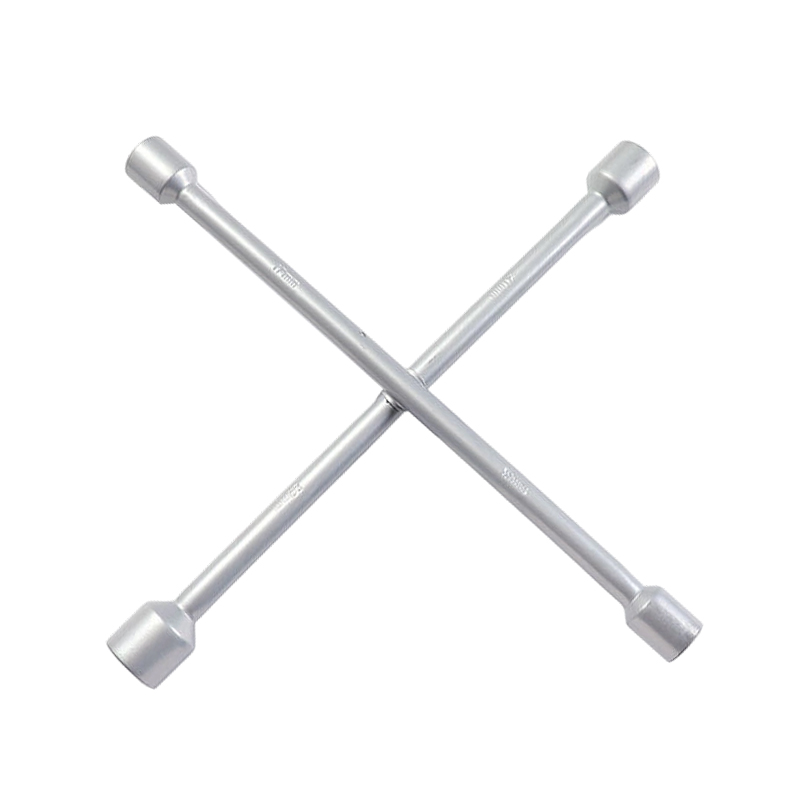
The defining mechanical advantage of a cross shape lug wrench over L-shaped or straight-handle designs is its bilateral arm structure. When both hands grip opposite arms simultaneously and push in opposite directions, the effective lever length doubles compared to a single-arm tool of the same arm length. A cross wrench with 300 mm arms on each side delivers the same torque as a 600 mm single-arm bar — without the awkward reach or balance problems of an oversized straight wrench.
The cross configuration also enables a "spinning" technique where the user grasps one horizontal arm and rotates the entire tool like a wheel after the nut is initially broken loose. This significantly accelerates nut removal and reinstallation compared to the ratcheting motion required with an L-shaped wrench. In timed trials, experienced technicians can remove and reinstall a full set of five lug nuts 30–40% faster with a cross shape lug wrench than with an equivalent L-shape tool — a measurable efficiency gain in fleet maintenance and roadside assistance contexts where time is a direct cost.
Four-Socket Configuration Strategy: How to Specify Socket Combinations for Maximum Vehicle Coverage
A cross shape lug wrench carries up to four sockets — one at each arm end — making socket combination selection the single most consequential specification decision for aftermarket and fleet procurement. A poorly chosen combination covers one vehicle class well and leaves gaps everywhere else; a well-planned combination turns one tool into a genuine universal solution for a mixed fleet.
The most effective four-socket combinations are built around two principles: covering adjacent size steps within a vehicle class, and spanning two different vehicle classes in one tool. The table below illustrates common combination strategies and the fleets they serve:
| Socket Combination |
Vehicle Coverage |
Best For |
| 17 / 19 / 21 / 23 mm |
Passenger cars through mid-size SUVs |
Passenger vehicle aftermarket kits |
| 19 / 21 / 22 / 24 mm |
SUVs, MPVs, pickups, vans |
Mixed SUV and light commercial fleets |
| 21 / 22 / 24 / 27 mm |
Full-size SUVs, vans, light trucks |
Commercial vehicle and logistics fleets |
| 17 / 19 / 21 / 22 mm |
Broad passenger to SUV coverage |
Universal roadside assistance kits |
Cross wrenches with only two socket sizes — one on each opposing pair of arms — are also common and lower in cost, but they reduce the tool's versatility to two vehicle classes. For OEM kit applications where the vehicle has a single known lug nut size, a two-socket cross wrench with the correct size plus a common adjacent size is often the most cost-efficient specification. For aftermarket sale, four-socket configurations command a modest price premium but significantly widen the potential buyer base.
Why SUVs, Pickups, and Vans Specifically Benefit from a Cross Shape Lug Wrench
The suitability of a cross shape lug wrench for SUVs, pickup trucks, and vans is not merely a matter of socket size — it is driven by the torque specifications of these vehicles' lug nuts, which exceed what most L-shaped or straight-handle wrenches can reliably deliver without excessive physical effort. Understanding the torque gap explains why the cross configuration is the practical default for these vehicle classes.
Typical OEM lug nut torque specifications by vehicle class:
- Compact passenger cars: 80–110 Nm — manageable with a standard L-shaped wrench under normal conditions.
- Mid-size sedans and hatchbacks: 100–130 Nm — at the upper limit of comfortable L-shape use; cross wrench noticeably reduces effort.
- SUVs and MPVs: 120–160 Nm — where the bilateral torque input of a cross wrench shifts from convenience to practical necessity for average-strength users.
- Pickup trucks: 140–200 Nm — the cross configuration and longer arm length of a dedicated truck-spec wrench make nut removal achievable without impact tools.
- Vans and light commercial vehicles: 160–250 Nm — at the high end, even a cross wrench benefits from a longer arm or a cheater extension; this range is where telescopic cross wrenches add meaningful value.
Beyond torque, these vehicle types tend to have lug nuts that see higher corrosion exposure — pickup trucks operating off-road, vans used in coastal delivery routes, SUVs driven through winter road salt. A seized nut that has corroded onto the stud for several years requires shock-breaking, where a rapid downward strike on one cross arm generates an impact force that a steady-push L-wrench cannot replicate. The mass and rigidity of a properly forged cross shape lug wrench contribute to this shock-breaking capability.
Arm Length Asymmetry and Center-Join Geometry: Engineering Details That Separate Quality Cross Wrenches
From a distance, all cross shape lug wrenches look structurally similar. The engineering differences that determine long-term performance are concentrated in two areas: the arm length ratios and the geometry of the center join where the two bars intersect.
Arm Length Design
Most cross wrenches use equal-length arms — typically 280–350 mm per arm on passenger/SUV tools, extending to 380–420 mm on heavy-duty commercial-vehicle designs. Some designs deliberately offset arm lengths to improve ground clearance when working on vehicles with low wheel arch clearance or to optimize the spinning motion for faster nut run-down. An asymmetric arm design requires more precise forging tooling and tighter length tolerances (±2 mm is standard; better manufacturers hold ±1 mm) to ensure balanced feel during rotation. Imbalanced arms cause the tool to wobble when spun, slowing nut run-down and increasing wrist fatigue.
Center Join Construction
The cross center is the highest-stress point of the entire tool — bending moments from both axes of loading converge there simultaneously. Three construction methods are used in the industry, with significantly different performance profiles:
- One-piece forged cross: The entire tool forged from a single steel blank. Maximum structural integrity at the center; no joint to fail. Higher tooling cost but the preferred method for professional and heavy-duty applications.
- Two-bar welded cross: Two straight bars welded at perpendicular center points. Weld quality is the critical variable — a full-penetration weld with proper pre-heat and post-weld heat treatment performs acceptably; an under-penetrated weld is a fatigue failure point under repeated high-torque use.
- Bolted or press-fit assembly: Common in low-cost consumer tools; the weakest option under high torque. Acceptable for light-duty passenger car nuts (under 120 Nm); not recommended for SUV or commercial vehicle applications.
Shanghai Soverchannel Industrial Co., Ltd., operating through Nantong Jinzhai Hardware Co., Ltd., applies full-process inspection that includes center-join weld quality verification and dimensional checks on arm length symmetry — particularly relevant for OEM and export customers where field returns are costly and traceability requirements are strict.
Force Distribution Across the Cross Pattern: Why Uniform Loading Protects Both the Tool and the Fastener
The phrase "uniform force distribution" applied to a cross shape lug wrench refers to two distinct phenomena that are worth separating: the distribution of grip force between the operator's two hands, and the distribution of contact force between the socket walls and the lug nut faces. Both matter, and both are influenced by tool geometry in ways that lower-quality designs ignore.
When both hands apply equal and opposite forces on a cross wrench's horizontal arms, the resulting torque at the socket is the sum of both contributions — with zero net bending moment transmitted to the socket-nut interface. This is the key advantage over single-arm tools: a single-arm wrench transmits both torque and a bending moment to the fastener, which can tilt the socket off-axis and generate uneven face contact with the nut hex. At high torque levels, this off-axis loading is what initiates corner rounding on the nut.
At the socket-nut interface, force distribution quality depends on three factors:
- Socket bore profile: Six-point (hex) sockets concentrate contact at flat faces, distributing force evenly across face width. Twelve-point (bi-hex) sockets engage at 30° offset points and are faster to engage but distribute force less evenly at high torques — a relevant trade-off for tight lug nuts on SUVs and vans.
- Socket wall parallelism: Tapered socket walls (where the bore is slightly wider at the mouth than the bottom) create concentrated contact at the nut corners rather than distributed face contact. This is a manufacturing defect in precision tools but is sometimes an intentional cost-reduction step in low-quality production.
- Surface hardness match: A socket significantly harder than the lug nut material (common when using hardened tool steel sockets on soft zinc-plated OEM nuts) can bite into the nut faces, making the socket stick on removal. Specifying socket hardness in the HRC 38–45 range avoids both excessive wear of the socket and excessive marking of the fastener.
Cross Shape Lug Wrench Arm Finish and Grip: Ergonomic Specifications That Affect Real-World Usability
A cross shape lug wrench is used under conditions that are rarely ideal — roadside in rain, cold garage floors in winter, hands that may be wet or oily. Arm finish and grip design directly affect whether the tool can be used safely and effectively in these conditions, yet they are among the most commonly underspecified aspects of tire wrench procurement.
Bare Steel Arms
Surface-treated bare steel arms (blackened, zinc-plated, or E-coated) are the lightest and most common construction. The limitation is grip: smooth steel arms become slippery when wet, increasing the likelihood of hands slipping under high torque. For OEM emergency kits where the wrench is used rarely and in controlled-enough conditions, bare steel is acceptable. For tools intended for regular use or commercial maintenance, additional grip features are worth specifying.
Knurled or Textured Arms
Cross-hatched knurling machined into the grip zone of each arm increases friction against the palm by 40–60% compared to smooth steel, based on standard slip-resistance testing. Knurling adds marginal cost (it requires a secondary machining pass) but significantly improves control during the spinning phase of nut run-down — where maintaining grip while rotating the tool quickly is the primary ergonomic challenge.
Rubber or Polymer Grip Sleeves
Overmolded or slip-on grip sleeves on the arm mid-sections provide the highest wet-condition grip performance and also reduce hand fatigue during repeated use. They add weight and cost, and require compatibility checking with the chosen surface treatment (some adhesive overmolding processes are not compatible with certain E-coat formulations). For professional-grade cross shape lug wrenches targeting fleet maintenance markets, grip sleeve specifications should be part of the product development conversation from the start — retrofitting them onto an already-specified bare-steel design creates adhesion and dimensional issues.
As an OEM/ODM manufacturer with full R&D integration, Shanghai Soverchannel Industrial Co., Ltd. supports grip design customization at the product development stage, drawing on the same engineering capability used for complex special-shaped fastener components to optimize arm cross-section, knurl pattern, and overmold compatibility for specific customer programs.
Procurement Checklist: What to Verify Before Sourcing a Cross Shape Lug Wrench at Volume
Volume procurement of a cross shape lug wrench — whether for OEM vehicle kits, retail aftermarket channels, or fleet maintenance supply — involves a set of verification steps that go beyond simply requesting a sample and approving the price. The following checklist reflects the quality assurance checkpoints that experienced automotive fastener buyers apply before committing to a production run.
- Material certification: Request a mill certificate for the steel batch confirming grade (high-carbon or Cr-V), carbon content, and heat number. This enables batch traceability if a quality issue arises post-delivery.
- Forging process confirmation: Verify whether the cross body is one-piece forged, two-bar welded, or assembled. For SUV and commercial vehicle applications, one-piece forged or full-penetration welded construction should be specified.
- Heat treatment records: Confirm that quench-and-temper treatment was applied and request the tempering temperature range used. HRC 38–45 at the socket wall is the target range for tool steel lug wrenches.
- Socket bore dimensional report: Request a First Article Inspection Report (FAIR) or incoming inspection data showing bore dimensions across flats, bore depth, and concentricity for each socket size in the combination.
- Surface treatment salt-spray hours: Specify the minimum salt-spray hours per ISO 9227 for the chosen finish (minimum 120 hours for zinc plate; 480+ hours for E-coat on export programs) and request test certificates from the supplier's coating process.
- Torque performance test: Verify that the wrench can apply 1.5× the target vehicle's lug nut torque spec without permanent handle deformation. This test should be performed on production samples, not only on hand-selected prototypes.
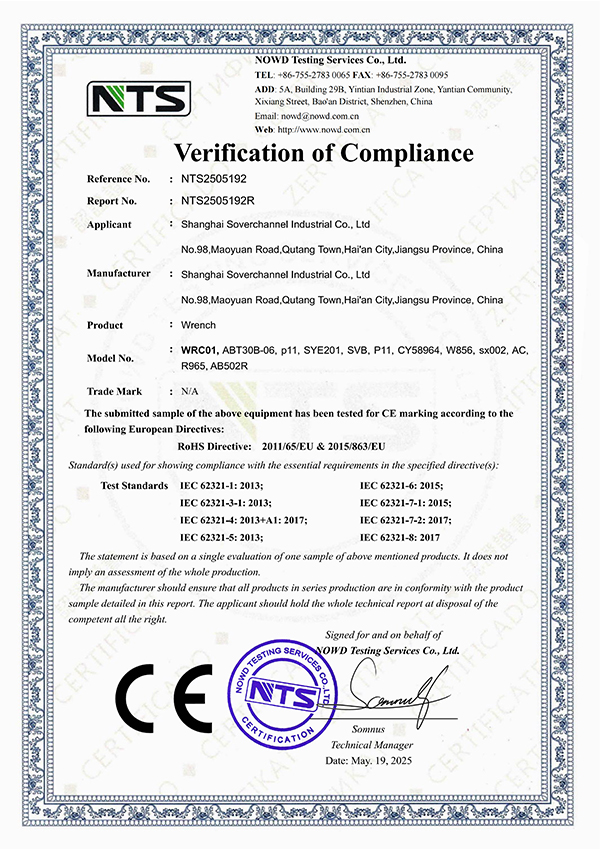
- Compliance documentation: For export to European markets, confirm IMDS submission capability and RoHS/REACH substance compliance. For North American OEM programs, confirm PPAP documentation readiness.
Shanghai Soverchannel Industrial Co., Ltd. is structured to support all of these verification requirements as part of its standard OEM supply process. The company's manufacturing base at Nantong Jinzhai Hardware Co., Ltd. operates a full-process inspection system that generates the documentation needed for automotive-grade sourcing decisions — from raw material intake through finished goods outgoing inspection — making it a dependable partner for both high-volume standardized cross shape lug wrench programs and custom-configuration development projects.